
Radiotherapy
All employees of the department dedicate themselves day by day to excellent patient care in the clinic, as well as to research, teaching, and training. We guarantee our cancer patients individualized treatment based on the latest scientific and technological standards.
Radiation oncology uses high-energy X-rays as a form of treatment. Radiation is used to treat many different diseases, but it is one of the most important treatments for both benign and malignant tumors. Radiation is also used to treat chronic inflammatory diseases (arthritis, etc.). We offer innovative treatments such as intensity-modulated radiotherapy in all its facets (IMRT, VMAT, SRT, SBRT, stereotactic radiotherapy, etc.).
Usually, radiation is used in an attempt to cure patients with cancer, either alone or in combination with other therapies. Radiation can reduce tumors before surgery, making them easier to remove. After surgery, radiation can then be used to destroy any remaining tumor cells (microscopic residual diseased cells) and thus prevent a relapse. Even if a cure is not possible, radiation can also have a palliative effective, reducing the patient’s pain and increasing its comfort. Indeed, radiation is one of the most effective means for treating tumor-related pain.
In our clinic, you can be assured that your pet will be treated with the most modern radiation equipment, techniques, and methods. Our linear accelerator is one of the best devices in Europe’s veterinary medicine.
Indicators for radiation therapy include:
- brain tumors
- nasal cavity tumors
- oral cavity tumors
- tumors in the auditory canal
- soft tissue sarcomas and mast-cell tumors (in combination with surgery)
- anal gland tumors, incl. lymph node metastasis
- thyroid tumors
- bladder and prostate tumors
Stereotactic Radiation Therapy
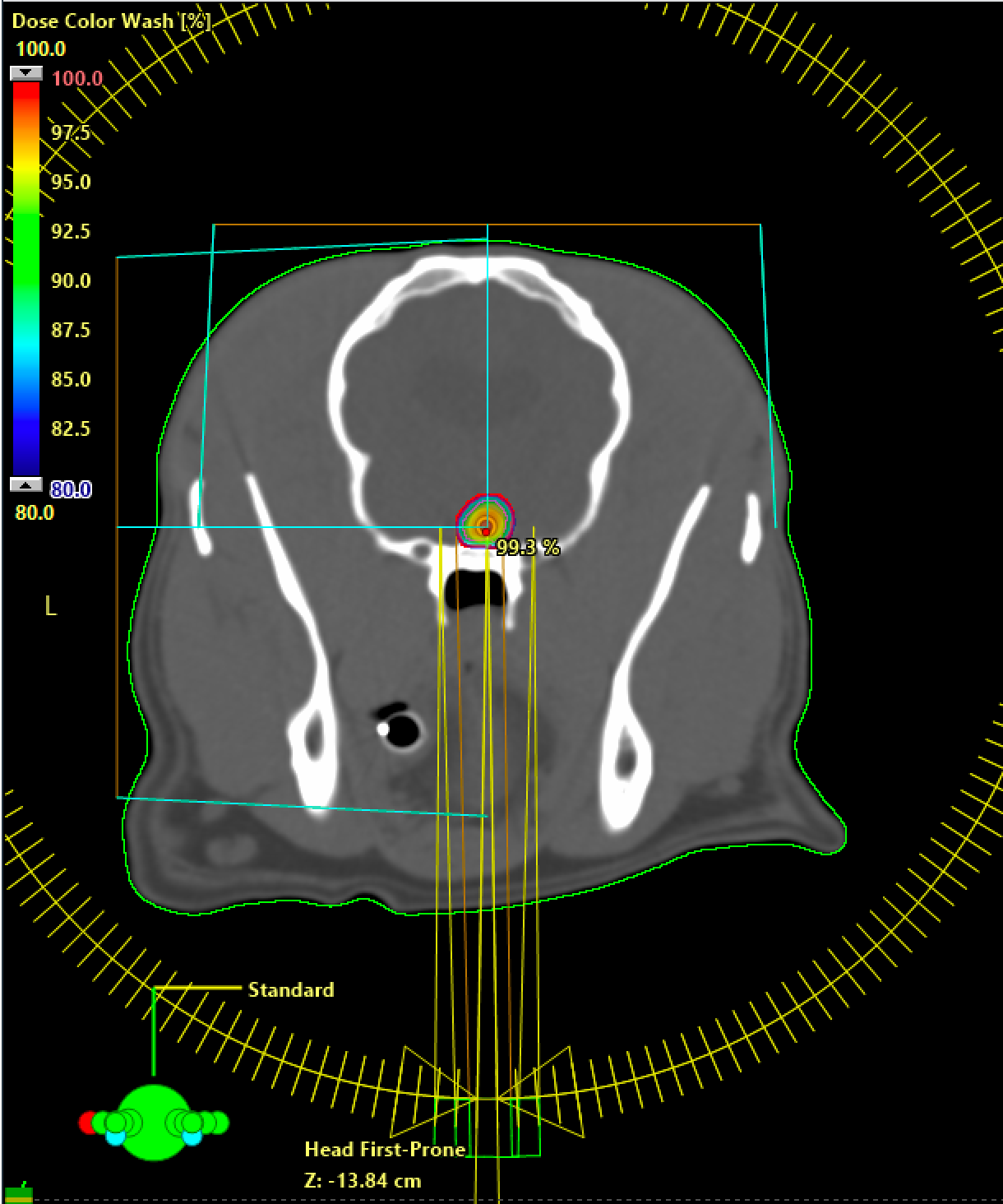
Stereotactic radiation therapy is a highly precise method used to treat certain tumors. High-dose radiation is directed specifically at the tumor tissue, while surrounding healthy tissue is preserved as much as possible. This method is particularly suitable for small tumors in the brain, as well as those located at the base of the heart, adrenal glands, or liver. Treatment is usually performed on an outpatient basis in 3–5 sessions. Thanks to precise planning, it is highly effective and causes relatively few side effects.
Suitable tumor types:
- Pituitary tumors, meningiomas, trigeminal nerve tumors
- Large, inoperable tumors of the adrenal gland, heart base, liver, and lungs
- Bone tumors with stable structure
Contact
Ideally you will be referred by your private veterinarian.
You are also welcome to contact us directly for an appointment:
We do not offer consultations by email or telephone.

We will be happy to explain the technical process of the therapy to you.
We would be happy to explain the process of the Radiation Therapy to you.
Side effects of radiotherapy occur when healthy cells surrounding the tumor are also damaged by the radiation or when diseased cells die and are absorbed by the body. To keep the side effects as low as possible, we plan to pinpoint the radiation of the affected area as precisely as possible so that the surrounding healthy tissue is spared as much as possible.
Before each treatment session, your pet will be examined by the treating veterinarian. Through close monitoring, it is possible to treat the side effects of the treatment individually and thus keep the amount of medication required as low as possible. We will inform you regularly about our assessment and will instruct you on how to care for any side effects. Please do not hesitate to tell us of any changes in your pet’s behavior at home and let us know your concerns.