

Radio Therapy process

Initial Consultation

We are happy to explain here the various steps involved in the treatment. When your pet has been diagnosed, you are in a new situation and are understandably unsure what to expect from radiation treatment. It is helpful for you to know and understand what will happen so that you can focus together with us on helping your pet recover.

We will not perform any treatments during your first visit to the radiation oncology department. During this initial consultation, we will have a detailed discussion about the symptoms and discomfort your pet may be experiencing and we will examine your pet closely. Any existing findings about this or other pre-existing diseases will, in the best-case scenario, have been investigated beforehand and discussed with your referring veterinarian.

Before beginning radiation therapy, this study often includes radiological imaging (X-rays, CT, or MRI scans) so we can identify the exact extent of the tumor. This imaging will help us to obtain a comprehensive picture of your pet’s health so that we can discuss the therapeutic process with a look ahead to future outcomes. Once the tests are complete, we will then discuss in detail the nature, status, and location of the tumor, the available treatment options, the prognosis, and the duration and course of treatment, including possible side effects.

Take advantage of this consultation to get answers to your questions.
Planning CT / Location

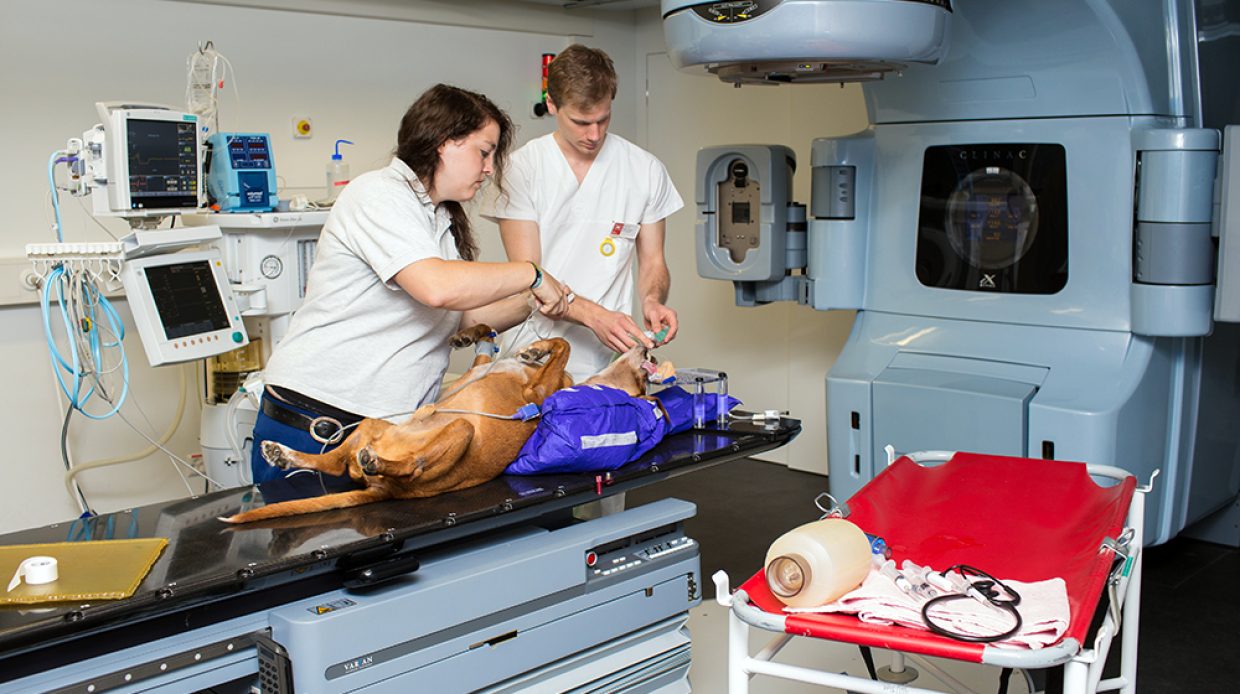
In order to be able to calculate the exact distribution of the radiation in the tumor and the surrounding tissue, we need information about the locations of your pet’s organs and bones. This will help us to prevent damaging the surrounding healthy tissue as much as possible. The locations are defined during a CT so that the patient can be positioned in the same position for each treatment. To increase the accuracy of the treatment, locations are selected that would minimize movement during the treatment session. We will put your animal under anesthesia for a short while during the treatment process. This will help to ensure that the treatment can be administered accurately. We also use different tools such as a positioning cushion and an individual bite blocks to keep your pet’s body from moving.

Treatment Planning

Based on the CT scans, we will create the optimal treatment plan for your pet. The aim of the treatment plan is to deliver a sufficiently high radiation dose to the tumor while sparing the surrounding healthy tissue as much as possible.
The plan is calculated using a special computer program, just as is done in human oncology. The radiation treatment plan is then created by our radio-oncologists with these images, so that the radiation can then be administered precisely to the tumor. The treating oncologist uses the CT scans to define the target volume in the individual CT sections. This includes not only the tumor, but also any possible microscopic spread of cancerous cells into surrounding healthy tissue and another small safety margin. This safety margin covers the uncertainties of radiation therapy such as patient positioning. This three-dimensional model of the patient’s tumor is then used to create an optimal treatment plan. Depending on the sensitivity of the surrounding organs, the latest radiation technologies, such as IMRT, are planned. IMRT (intensity-modulated radiation therapy) involves radiating the tumor not just from different directions, but with different intensities. At the end of the treatment planning, the doctor will have decided the direction and field of radiation in order to treat the patient’s specific disease. This treatment planning usually takes about three to four days.

For each exposure to the radiation, the patient is put into the same position as during the planning CTs. This is where the positioning aids come in handy. Once positioned, an X-ray or a quick CT is made to make sure that the position is right before the radiation is applied. This gives us another chance to check whether the tumor will be targeted precisely by the treatment. The radiation itself only takes a few minutes and is painless for the patient.

The treatment will then be given in multiple sessions, so that the tissue surrounding the tumor is not too badly damaged. Depending on the disease and your pet’s age, this may require between 3 and 20 sessions, preferably within short succession.

We will clarify the following organizational issues in advance:

  • When, where, and over what period of time will the treatment sessions take place?
  • Can you bring your pet daily or will your animal stay with us for a certain amount of time?
  • Does your pet have special needs such as special food, medicines, etc.?
  • What kind of support are you able to offer your pet during treatment?

Radiation

linear accelerator is used to apply the radiation. For reasons of radiation protection, this is located in an isolated areas in the basement of our building. To ensure that patients remain very calm during treatment, we will use general anesthesia for a short period during each treatment. A single treatment session lasts about an hour, where the radiation itself only lasts about 10-15 minutes. After treatment, which is painless for the animal, we allow your pet to waken naturally so that the treatment sessions are as stress-free as possible.

Please remember that we stand behind the technology and we are here for you and your pet.

For organizational questions, our veterinary medical practice assistants are available and responsible: +41 44 635 83 24

We will forward medical questions to the treating doctor.

For organizational questions, our veterinary medical practice assistants are available and responsible: +41 44 635 83 24

We will forward medical questions to the treating doctor.

Vorbereitungen in der Onkologie.

Suche

Öffnungszeiten über Weihnachten

Über die Weihnachtsfeiertage arbeitet das gesamte Universitäre Tierspital Zürich im Notfallbetrieb. 

Von Mittwoch, 24. Dezember 2025, ab 12:00 Uhr bis einschliesslich Sonntag, 28. Dezember 2025 sind wir für Notfälle rund um die Uhr erreichbar. 

Bitte melden Sie sich im Notfall vorab telefonisch an. 

Regulärer Betrieb: Für Terminvereinbarungen und weitere Dienstleistungen stehen wir Ihnen ab Montag, 29. Dezember 2025 zur Verfügung. 

Besuchszeiten 

Kleintierklinik: Heiliger Abend (24.12.), 1. Weihnachtstag (25.12.) und 2. Weihnachtstag (26.12.): 18:00 – 20:30 Uhr 
Samstag (27.12.) und Sonntag (28.12.): keine Besuche möglich 

Pferdeklinik: 
Heiliger Abend: (24.12.) 12:00 – 13:00 Uhr und 17.00 – 20.00 Uhr
Weihnachtstag (25.12.) bis Sonntag (28.12.): 12:00 – 20:00 Uhr 

Vielen Dank für Ihr Verständnis. Wir wünschen Ihnen und Ihren Tieren frohe Weihnachten!